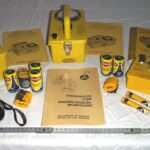
Geiger counters have long been used in the recovery of exotic materials that may contain radioactive particles. From detecting meteorites to space debris the instruments have held their place in modern history since the dawn of the atomic age. In 1979 the instruments played a significant role in the recovery [...] Read more →
Science in Plain English · Particle Physics · 2023 A plain-English review of the landmark 2023 ALPHA experiment that finally answered one of the oldest questions in physics — and why one man who died in 1727 deserves a share of the credit. Reviewing: Anderson et al., [...] Read more →
In December 1980, US Air Force personnel encountered an unknown craft in a Suffolk forest over three nights. The deputy base commander recorded it in real time. The tape is public domain. In the early hours of December 26, 1980, a security patrol at RAF Woodbridge in Suffolk, England reported [...] Read more →
Roughly 44,000 kilograms of meteoritic material falls on Earth every day. Most of it lands in the ocean or burns up entirely on the way down, but a meaningful fraction reaches the surface intact, and some of that ends up in fields, deserts, dry lake beds, and beaches where a metal detector [...] Read more →
SDR Radio for Beginners: How to Listen for Anomalous Signals A $25 USB dongle has turned an entire generation of hobbyists into radio operators without licenses, technical training, or any hardware beyond a laptop. That’s not an exaggeration — the RTL-SDR dongle, originally designed as a cheap television receiver for [...] Read more →
The Money Pit was discovered in 1795 by a teenager named Daniel McGinnis who found a circular depression in the ground on a small island off the coast of Nova Scotia and started digging. Oak platforms appeared every ten feet. At ninety feet, the bottom flooded with seawater through a system of [...] Read more →
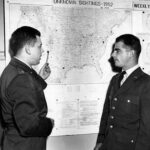
Edward James Ruppelt – St. Louis Post-DispatchPhoto published on Mar 08, 1953 From 1952 to 1969, the United States Air Force ran the longest official UFO investigation in American history out of Wright-Patterson Air Force Base in Ohio. They called it Project Blue Book, and by the time they shut it [...] Read more →
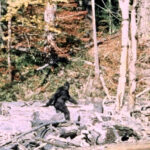
The argument about Bigfoot tends to go one of two ways: either you’ve never looked at the evidence closely and think it’s obviously ridiculous, or you have looked at it and can’t quite explain certain things away. The serious researchers — and there are serious researchers — don’t claim certainty. They claim [...] Read more →
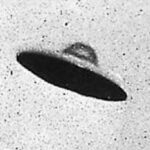
A photo of a purported UFO over Passaic, New Jersey in 1952. (Photo by: Universal History Archive/Universal Images Group via Getty Images) Before 2017 the standard government position on UFOs was approximately: not our department, probably misidentifications, please stop asking. That position collapsed in December of that year when the New [...] Read more →
When you leave Earth’s timezones behind, how do astronauts keep track of time — and how long does it take to get there in the first place? [...] Read more →
Most people who want to run a serious sky-watch spend about forty-five minutes planning the observation setup and then three hours sitting in an uncomfortable chair getting cold. The uncomfortable chair problem is actually important — if you’re miserable by midnight you’ll pack up before anything happens, and the most interesting things at [...] Read more →
When Lieutenant Colonel Charles Halt walked into Rendlesham Forest in December 1980 with a team of airmen, he brought a radiation detector. This wasn’t theatrical — it was standard procedure for a military officer investigating an unknown object near a base that housed nuclear weapons. What his equipment found was elevated radiation [...] Read more →
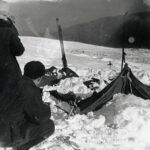
Russian Officials examine camp site. On January 23, 1959, ten students and young graduates from the Ural Polytechnic Institute set out for a winter trek through Russia’s northern Ural Mountains. One turned back after a few days with joint pain. The other nine continued. Their leader was a 23-year-old engineering student [...] Read more →
Click here to read a copy of The Anti-Gravity Bible Read more →
Author’s Note ON APRIL 27, 1949, the U.S. Air Force stated: “The mere existence of some yet unidentified flying objects necessitates a constant vigilance on the part of Project ‘Saucer’ personnel, and on the part of the civilian population. “Answers have been—and will be—drawn from such factors as [...] Read more →
|
Project Blue Book: What the US Air Force Actually Found 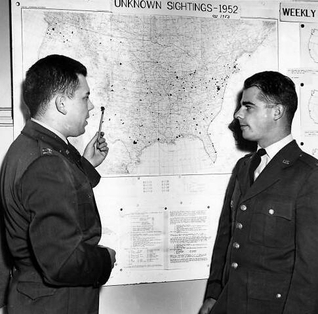 Edward James Ruppelt – St. Louis Post-Dispatch
Photo published on Mar 08, 1953 From 1952 to 1969, the United States Air Force ran the longest official UFO investigation in American history out of Wright-Patterson Air Force Base in Ohio. They called it Project Blue Book, and by the time they shut it down, they had collected reports on 12,618 sightings. Of those, 701 were closed as “unidentified” — meaning trained investigators looked at them and couldn’t explain what they were.
That number matters. The Air Force’s own accounting, preserved at the National Archives in Washington where the files are still publicly available, shows that roughly one in eighteen cases had no explanation after professional analysis. The government’s official position was that none of this represented a threat to national security and none of it pointed to extraterrestrial technology. But the man they hired to be their chief scientific consultant eventually stopped believing that.
J. Allen Hynek was an astronomer brought on specifically because he was a skeptic. The Air Force wanted someone credible who would help explain things away. For years that’s what he did. By the end of his tenure he wasn’t so sure. He later founded the Center for UFO Studies, coined the term “close encounters,” and spent the rest of his career arguing that the subject deserved serious scientific investigation rather than institutional debunking. That’s a notable journey for a man who started the job as a true believer in conventional explanations.
The most serious analysis Blue Book ever produced came from the Battelle Memorial Institute, a respected Ohio research organization. Between 1952 and 1954, Battelle analysts coded roughly 3,200 cases onto IBM punch cards and ran a statistical analysis — the largest such study of UFO reports ever conducted. Their report, Special Report No. 14, found that the “unknown” cases were not random noise. They were statistically distinct from the “known” cases across multiple variables including speed, shape, and observer reliability. The better the witness, the more likely the case ended up unexplained.
None of this made it into the Air Force’s public communications at the time. A CIA panel called the Robertson Panel met secretly in 1953 and concluded that the real problem wasn’t the sightings — it was public interest in the sightings. Their goal, declassified in 1979, was to reduce that interest through a debunking campaign. The panel ran for three days, reviewed six years of data, and decided the whole thing wasn’t worth investigating further.
Two of the cases that survived every explanation attempt are worth knowing. In July 1952, radar operators and pilots tracked unknown objects over Washington DC for several nights running. The Air Force eventually blamed temperature inversions. In 1964, a New Mexico state police officer named Lonnie Zamora watched an oval craft land in the desert outside Socorro, observed two small figures near it, and found physical trace evidence on the ground afterward. Hynek personally investigated it and called it one of the most credible cases in the entire Blue Book archive. It remains officially unexplained.
The complete Blue Book files are public domain, housed at the National Archives and digitized on platforms like Fold3. Anyone can read them. That’s either the government being admirably transparent about an embarrassing chapter, or a very effective way of hiding what mattered by burying it in 129,000 pages of paperwork. Probably a bit of both.
|
|