










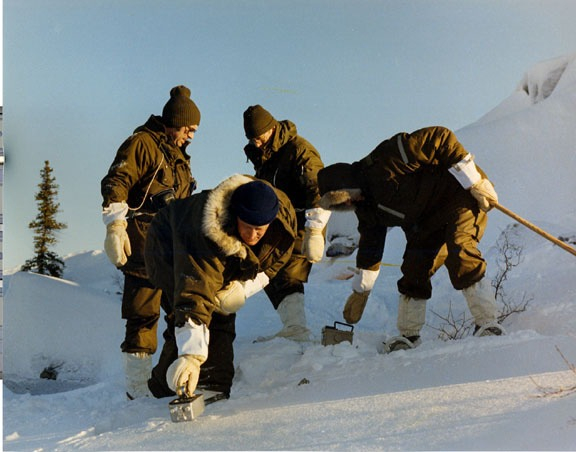
Geiger counters have long been used in the recovery of exotic materials that may contain radioactive particles. From detecting meteorites to space debris the instruments have held their place in modern history since the dawn of the atomic age. In 1979 the instruments played a significant role in the recovery of a wayward Russian satellite, the Cosmos 954. Just so you understand, in American speak, only commies use a K in the word Cosmos. That comes from the pride real patriotic Americans working during Cold War days when the threat of nuclear annihilation was at its peak. So, the US Depart. of Energy documents will use a C when referring to the Russian satellite. During the cold war days, the Russians used nuclear power in a myriad of ways from powering radio beacons to fueling operational satellites.
Click here to read a short brief on the retrieval of the satellite by the U.S. Department of Energy.
From the Nuclear Regulatory Commission we learn the following about Geiger Counters:
The Geiger counter — an instrument that can detect radiation.
Just to recap, the core of an atom (the nucleus) is surrounded by orbiting electrons, like planets around a sun. The electrons have a negative charge and usually cancel out an equal number of positively charged protons in the nucleus. But if an electron absorbs energy from radiation, it can be pushed out of its orbit. This action is called “ionization” and creates an “ion pair”—a free, negatively charged electron and a positively charged atom.
Humans cannot detect creation of an ion pair through their five senses. But the Geiger counter is an instrument sensitive enough to detect ionization. Most of us have heard or seen a Geiger counter. They are the least expensive electronic device that can tell you there is radiation around you—though it can’t tell you the original source of the radiation, what type it is or how much energy it has.
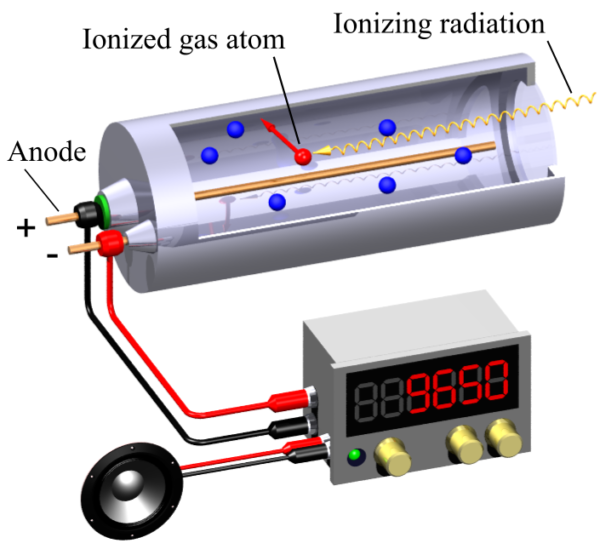
How does it work? A Geiger counter has two main parts—a sealed tube, or chamber, filled with gas, and an information display. Radiation enters the tube and when it collides with the gas, it pushes an electron away from the gas atom and creates an ion pair. A wire in the middle of the tube attracts electrons, creating other ion pairs and sending a current through the wire. The current goes to the information display and moves a needle across a scale or makes a number display on a screen. These devices usually provide “counts per minute,” or the number of ion pairs created every 60 seconds. If the loud speaker is on, it clicks every time an ion pair is created. The number of clicks indicates how much radiation is entering the Geiger counter chamber.
You hear a clicking sound as soon as you turn on the speaker because there is always some radiation in the background. This radiation comes from the sun, natural uranium in the soil, radon, certain types of rock such as granite, plants and food, even other people and animals.
The background counts per minute will vary; the needle will move or the number will change even when there is no know radiation source nearby. Many different things cause this fluctuation, including wind, soil moisture, precipitation (rain or snow), temperature, atmospheric conditions, altitude and indoor ventilation. Other factors in readings include geographical location (higher elevations give higher counts), the size and shape of the detector, and how the detector is built (different chamber material and different gases).
Depending on the elevation and the type of Geiger counter, a typical natural background radiation level is anywhere from five to 60 counts per minute or more. Because background radiation rates vary randomly, you might see that range standing in one spot. It is important to understand that the Geiger counter indicates when an ion pair is created, but nothing about the type of radiation or its energy.
Other types of instruments can provide an exposure rate (expressed as milliroentgen per hour or mR/hr). These counters must be calibrated to read a particular type of radiation (alpha, beta, gamma, neutron, x-ray) as well as the amount of energy emitted. The reading will only be accurate for that type of radiation and that energy level. And these instruments need to be calibrated regularly to be sure they are providing correct information over time.
For more sophisticated environmental radiation readings, check out the Environmental Protection Agency’s nationwide system, RadNet. Using equipment far more sensitive than a Geiger counter, it continuously monitors the air and regularly samples precipitation, drinking water and pasteurized milk.
Over its 40-year history, RadNet has developed an extensive nationwide “baseline” of normal background levels. By comparing this baseline to measurements across the U.S. states in March 2011, following the accident at the Fukushima reactors in Japan, the EPA was able to detect very small radiation increases in several western states. EPA detected radiation from Japan that was 100,000 times lower than natural background radiation—far below any level that would be of concern. And well below anything that would be evident using a simple Geiger counter, or even Geiger counters spread across the country.
If RadNet were to detect a meaningful increase in radiation above the baseline, EPA would investigate immediately. With its nationwide system of monitors and sophisticated analytical capability, RadNet is the definitive source for accurate information on radiation levels in the environment in the U.S.
By the way, the Geiger counter is also called a Geiger-Mueller tube, or a G-M counter. It was named after Hans Geiger, a German scientist, who worked on detecting radiation in the early 1900s. Walter Mueller, a graduate PhD student of Geiger’s, perfected the gas-sealed detector in the late 1920s and received credit for his work when he gave his name to the Geiger-Mueller tube.